Even as the Jammu and Kashmir (J&K) Assembly elections are in progress, a big political irony is playing out. Though he has long been a BJP man, Ram Jethmalani has gone ballistic in opposing the party’s original dream of abrogating Article 370.
In July this year his regular column in a Sunday newspaper, warned the BJP against tinkering with Article 370. His argument was that the Article had become a “basic structure” of our Constitution as described by the Supreme Court in the Keshavananda Bharati case (AIR 1973 SC 1461) and, therefore, could not be touched. Then, a week or so ago, he expressed the same view from a public platform. He also informed us then that he had written a letter on the subject to Prime Minister Narendra Modi.
Perhaps, the 91-year-old eagle of criminal law has forgotten that Article 370 has been categorised in our Constitution only as a “Temporary” provision” right from the inception of our Constitution till date. Hence, dubbing a law not yet made “Permanent” as a “basic structure” of our Constitution is laughable.
Moreover, the Article that inflicts national humiliation by permitting certain laws of the august Parliament to J&K State only with the concurrence of that State’s Government can hardly be considered as a “basic feature” of the nation’s Constitution.
More importantly, the Keshavananda Bharati verdict on what constituted the “basic structure” of our Constitution and therefore could not be amended was specifically with reference to all that was proclaimed and promised in its Preamble. Because Justice, Liberty and Equality are among the objectives assured in the Preamble our national Constitution (and in the prevalent J&K State Constitution) the right to social and economic justice constitutes a “basic structure” of the two Constitutions. And, therefore, any legal provision that results in economic and social inequality and opportunities violates the sacred concept of a “basic feature” of the Indian Constitution (Valsamma Paul vs Cochin University, AIR 1996 SC 1011) as well of the J&K Constitution.
That violation is precisely what was done by the creation of a new Article 35A applicable only to J&K State. It was done by “The Constitution (Application to Jammu and Kashmir) Order of May 1954 which, by a quick count, had 106 “exceptions and modifications”, apart from the omission of the whole of each of 86 Articles of the Indian Constitution, being made application to J&K. That Order was, with the concurrence of the J&K State Government, issued by the President of India in exercise of the powers conferred on him by clause (1) of Article 370.
Over the years, that Article 35A has become an ogre, the social and economic aspirations of many thousands of people, men and women, inside and outside J&K.
To comprehend this assessment, see its wording quoted below:
Quote: “35A.Saving of laws with respect to permanent residents and their rights. Notwithstanding anything contained in this Constitution, no existing law in force in the State of Jammu & Kashmir, and no law hereafter enacted by the Legislature of the State –
(a) defining the classes of persons who are, or shall be, permanent residents of the State of Jammu & Kashmir; or
(b) conferring on such permanent residents any special rights and privileges or imposing upon other persons any restrictions as respects-
(i) employment under the State Government;
(ii) acquisition of immovable property in the State;
(iii) settlement in the State; or
(iv) right to scholarships and such other forms of aid as the State
Government may provide shall be void on the ground that it is inconsistent with or takes away or abridges any rights conferred on the other citizens of India by any provisions of this part.”
Unquote
The above provisions of Article 35A were sanctified in the Jammu and Kashmir State Constitution adopted in November 1956 by creating a privileged category designated as “Permanent Residents” among all the residents of the State. Section 6 of the State Constitution spells out requirements to qualify as a “Permanent Resident” (PR). Essentially, a PR was to be an Indian citizen on May 10, 1954 and a State Subject of J&K (as per the 1927 Notification issued in the State) and who, having lawfully acquired immovable property in the State, had been ordinarily
resident in the State for not less than 10 years prior to May 10, 1954.
resident in the State for not less than 10 years prior to May 10, 1954.
There is only a small difference in the qualification of those who having earlier migrated to Pakistan had returned to J&K. After the State Constitution came in force, gradually came the laws that conferred extraordinary privileges on this entity of Permanent Residents, leaving the other residents of the State high and dry.
With the blessings of Article 35A, the Jammu & Kashmir State Legislature has enacted laws that actually confer certain rights and privileges on Permanent Residents while denying them to those who are not the State’s Permanent Residents. According to Arvind P Datar, senior advocate, Chennai, for example,
1. Only Permanent Residents are entitled to transfer any land in their name.
(A corollary is that a non-PR cannot acquire any immovable property in J&K)
2. In terms of Rule 17 of the Jammu & Kashmir Civil Services Rules, employment under the Jammu & Kashmir Government is permitted only to Permanent Residents but denied to other State residents persons even though they are citizens of India.
3. A person who is not a Permanent Resident is disqualified from being a member of a Village Panchayat under Section 6(a) of the Panchayati Raj Act, 1989.
Similarly, those who are not PR are denied State Government scholarships and even the right to contest for a seat in the Village Panchayat.
On top of the above, there is the provision in the State Constitution’s Section 140 which stipulates that “every person who is a permanent resident of the State…shall be entitled to be registered as a voter” for elections to the Legislative Assembly. Thus, those who are not PR of J&K but are otherwise Indian citizens residing in that State are eligible to vote for the Lok Sabha polls but not in the State Assembly polls!
The above perverse situation has led to frustration among thousands of Indian citizens in Jammu & Kashmir.
Women in J&K too have suffered as rules allowed by Article 35A prevent a Kashmiri woman married to an outsider is legally prevented from transferring her immovable property to her children.
All the above laws/rules violate the aforementioned Supreme Court verdict of Valsamma Paul vs Cochin Universiy that equality of status and opportunity promised to all citizens of India in the Preamble of the Constitution of India was, along with other ingredients therein, are a part of the “basic structure” of our Constitution and that any law, whether made in the exercise of the constituent power or ordinary legislative power, will be struck down as void if it violates the Constitution of India’s “basic structure”. Ram Jethmalani may kindly note that before once again telling us not to tinker with Article 370.
Meanwhile, what must Prime Minister Modi do with the advice he has received from the old man? Just acknowledge it and dump it. And irrespective of whether the BJP has put abrogation of Article 370 in its election manifesto or not, but goes on to form a Government of its own in J&K, the PM must
Step 1. Tell his Chief Minister to convey his Government’s concurrence to the nation’s President to issue, under clause (1) of Article 370, a Constitution Order (Application to Jammu and Kashmir) withdrawing Article 35A ab initio so that all the evils caused by in the past also become extinct.
Step 2. Tell his Chief Minister to give a similar concurrence to the President of India to issue another similar Constitution Order as above to remove the mischievous very last clause of Article 370 that, even today, requires the State Government to get the recommendation of the deceased Constitution to issue a Notification making Article 370 cease to operate.
Step 3. Tell his Chief Minister to give a similar concurrence to the President to issue a notification stating that Article 370 has ceased to be operative.

File photo of Jawaharlal Nehru and Sheikh Abdullah.

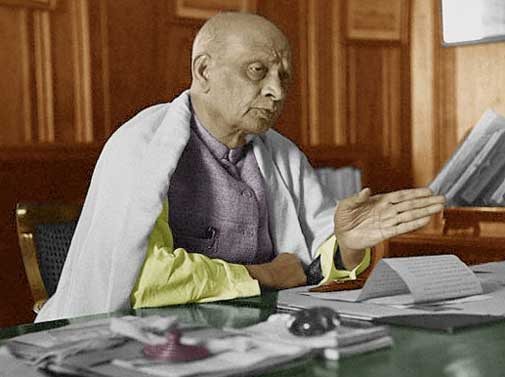 With great wisdom and political foresight, he consolidated the small kingdoms. The public was with him. He tackled the Nizam of Hyderabad and the Nawab of Junagarh who intially did not want to join India. There were a lot of problems connected with the reunion of the numerous states into India. Sardar Patel'suntiring efforts towards the unity of the country brought success. Due to the achievement of this massive task, Sardar Patel got the title of 'Iron Man'. ' He is one of the prestigious leaders of the world who became immmortal by uniting a scattered nation without any bloodshed. His enthusiasm to work for the independent nation got a big jolt when Gandhiji was murdered. Patel was very attached to Gandhiji and considered him, his elder brother and teacher. He was encouraged by Mahatma Gandhi in all his work. Gandhiji's death left him broken. On 15th December, 1950 he died of a cardiac arrest. The news of his death spread all over the world. The entire nation plunged into deep sorrow, everyday life came to a standstill. A grateful nation paid a tearful homage to it's beloved leader. In 1991 the grateful nation conferred upon him the honour of Bharat Ratna.
